Australian 1992 Mob of Roos Dollar

Circulation 1992 Mob of Roos One Dollar -we've made this one up, does it exist?

Circulation 1992 Mob of Roos One Dollar -we’ve made this one up, does it exist?

There’s a big question over whether this coin exists or not -the Stuart Devlin designed 5 kangaroos standard reverse design on the Australian one dollar coin dated 1992 and released into circulation. The Royal Australian Mint certainly think they minted some and released them into circulation but collectors who search bulk coins and browse their change think differently. No one has ever found one…not one.

The Royal Australian Mint website which lists Australian Dollar designs and mintages shows .008 million coins entering circulation, that’s 8,000 that have never been seen or found. Surely it’s a mistake or these would have showed up somewhere.

Well the odd one has. Back in February 2012 in Downies Australian Coin Auctions number 310 lot number 2493 was described as one dollar 1992 with mob of roos reverse struck on a partially prepared proof blank, as struck and extremely rare estimate $750 and sold for $1,000 ($1190 inc buyers premium). Collectors can recall a few others appearing for sale every now and then but these can be counted on one hand. This suggests they were struck as “mint sport” and not part of the elusive 8,000 circulation coins that have been misplaced!

Collectors have put their heads together and come up with a rather plausible explanation for the 8,000 coins that appear in the 1991-1992 Royal Australian Mint Annual Report. In 1992 one of the collector coin sets that was issued was the Australian One Dollar Five Coin Set. This set included restrikes of past dollars including mob of roos dollars dated 1984 and 1985 and the commemorative dollar for 1992 which was the Barcelona Olympic coin. Maybe an error in the RAM financial report declaring their production statistics was made and these coins have been misidentified in the report.

It may also be important to note that in 1988-1989 $36 million of $1 were repurchased back by the Royal Australian Mint from the Reserve Bank. Whether or not these were kept and reissued later or melted down is unclear. This may account for the 8,000 coins issued into circulation and explain that they are not dated 1992.

Just to add here the one dollar coin included in the 1992 Mint Set and 1992 Proof set was the commemorative coin celebrating the Barcelona Olympic Games and this design was not released into circulation. It could also be struck on the gallery press at the Mint in Canberra or at the Royal Easter Show which may account for why the odd one has been found in circulation as it’s been spent. It has the commemorative reverse and not the standard mob of roos design.

Confused yet? Well the reality is if you’re searching circulation coins for a 1992 Mob of Roos to add to your collection you’ll be looking for some time, as far actual real collector statistics go, they simply cannot be found.

Posted in Collecting Coins, Error Coins

The Australian 20 Cent Coin

Platypus 20 Cent Coin Reverse (1972)

Platypus 20 Cent Coin Reverse (1972)

The Australian 20 cent coin has been minted since 1966 to the present day and is highly collected and loved. It has been released with many commemorative designs both for circulation and for the collector market. The swimming platypus reverse is the standard iconic design by Stuart Devlin.

The twenty cent is 28.52 millimetres in diameter and is struck on a round shaped copper-nickel planchet of 75% copper and 25% nickel. It has edge reeding or milling and weighs 11.31 grams, the same size and weight as a pre-decimal florin.

The standard reverse or tails side of the Australian 20 cent is the design of a swimming platypus by coin designer, sculptor and master silversmith Stuart Devlin. Of all the standard Australian circulating coin designs that Mr Devlin engraved this platypus is his favourite. There is a perception of depth in the design that he sought to capture with this coin winning the hearts of a nation. It is one of the most highly collected denominations.

Stuart Devlin now lives in England but in 1963 resided in Melbourne where he entered a competition to design the new decimal coins for the changeover to decimal currency in 1966. The decimal 20 cent would replace the silver one florin in the old money. The twenty cent platypus design carries Mr Devlins SD initials next to the to the claw at approximately 9pm.

The platypus design was not issued for circulation every year so some dates must be obtained from Mint Sets. Almost all the coins have been minted at the Royal Australian Mint in Canberra although in 1966 some coins were struck in London and in 1981 Wales and Canada. The Canadian coins having a distinctive missing claw (or 3.5 claws) mintmark/variety. One particular die that struck coins in London in 1966 had a wave on the top of the baseline of the 2 and is called the Wavy 2 or Wavy 20 variety, these coins can be found in your change and can be worth hundreds of dollars.

Many commemorative 20 cent coins have been struck for both circulation and collectors. It’s always a surprise to get something different in your change and discover what event or milestone Australia celebrates. We began to issue commemorative 20 cent coins in 1995 with the 50th anniversary of the United Nations and then theSir Donald Bradman tribute coin in 2001. Following this a barrage of commemorative coins entered circulation and many more were minted for collectors called NCLT that were released in special packaging but were not intended to circulate. The list of commemorative coins you could find in your change (at this time) is almost 20 different coins!

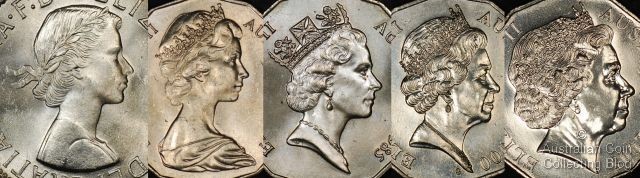
Every coin features the denomination on the reverse and the obverse has seen three different portraits of Queen Elizabeth II. From 1966 to 1984 the twenty cent was minted with the Arnold Machin portrait of the young Queen. From 1985-1998 it was struck with the Raphael Maklouf portrait and today (from 1999 to the present) we see the mature depiction of QEII by Ian Rank-Broadley.

Slight variations in the obverse design can be found with the Mint trialing newer technology resulting in 2004 a large head and small head Queen obverse and differences in the font of the IRB initials of designer Ian Rank-Broadley. In 2013 the Mint struck the platypus 20 cent piece in their 6 coin uncirculated set in hyper-metallic colour!

The Australian 20 cent platypus in colour!

The Australian 20 cent platypus in colour!

Error 20 cent coins can show up from time to time and can be very spectacular. Of particular rarity are the platypus 20 cent being struck on a Hong Kong $2 scallop shaped planchet of which only a handful are known and also the platypus design struck on a bi-metal planchet is sure to stick out and be noticed as something unusual! These are however coins made in error where wrong planchets have been mixed up in the barrels of blanks and can fetch thousands of dollars on the collector market. Other known 20 cent error coins are more commonly found but still keenly sought the partial collar error, clipped planchet error, split planchet error andlamination flaws.

To date over 1.8 billion uncirculated 20 cent coins have been minted to be carried around in Australian pockets! Check out the mintages in our handy online tool Australian Coin Mintages. This tool is a work in progress so please excuse it’s incompleteness.

Platypus 20 Cent Coin Obverses from left Machin, Maklouf and Rank-Broadley portraits of Queen Elizabeth II

Platypus 20 Cent Coin Obverses from left Machin, Maklouf and Rank-Broadley portraits of Queen Elizabeth II

Posted in Collecting Coins

2012 AFL Premiers 1 Dollar Corporate Functions Gift Pack

Australia 2012 AFL Premiers 1 Dollar Corporate Gift Pack

Australia 2012 AFL Premiers 1 Dollar Corporate Gift Pack

Unknown to the coin collecting community in 2012 the Royal Australian Mint in conjunction with Australia Post and the Australian Football League (AFL) released a commemorative 1 dollar coin which was distributed as a gift at AFL corporate functions in different packaging to what we’ve already seen this coin in. Officially released to stamp and coin collectors in a pnc (philatelic numismatic cover) this coin appears again with a small card in a sealed bag and was given away as memorabilia of the AFL 2012 season at official AFL corporate functions.

Update 2015: This special packaging issue appears for the first time in the 22nd (2015) edition of the McDonald’s pocket guide to Australian Coins and Banknotes catalogue. With an issue of 2,500 of these corporate gift packs it’s rare to see them for sale.

Australia 2012 AFL Premiers 1 Dollar

Australia 2012 AFL Premiers 1 Dollar

Posted in Collecting Coins

1988 Opening of Parliament House 5 Dollar ($5) Coin

Australia 1988 5 Dollar Coin Parliament House Opens

Australia 1988 5 Dollar Coin Parliament House Opens


In 1988 the Royal Australian Mint produced it’s first 5 dollar coin commemorating the opening of New Parliament House in Canberra. Celebrating it’s 25th birthday this year with the release of Australia’s first triangle shaped Parliament House silver proof 5 dollar coin we look back at the coin that brought new blood into collecting.

Three million of these uncirculated aluminium bronze 5 dollar coins were commissioned and distributed by the Commonwealth Bank at face value in 1988 in celebration of the opening of New Parliament House. They were issued in 2 types of similar packaging, a sealed cellophane type (seen here) and a pvc flip. Because they were so easy to obtain from your local Commonwealth Bank branch and quite special at the time these were collected and talked about sparking interest in collecting that has spanned decades.

Quite sadly though these 1988 Parliament House $5 coins were never a good long term investment on your 5 dollar outlay with the recommendation today is that you take your coin to the bank and redeem your $5 face value back.

Australia 1988 5 Dollar Coin Packaging

Australia 1988 5 Dollar Coin Packaging

Posted in Collecting Coins Tagged with: ,

Bottle Top Die Cap Coin Error

5 cent Die Cap

5 cent Die Cap

Have you ever seen a die cap, bottle cap or bottle top coin error? They are one of the rarest coin errors typically because such an error should never leave the manufacturing mint.

This Australian 5c bottle cap error started life as a regular struck 5c piece that remained attached to the hammer or top die during the minting process. After it stuck to the die it was this 5c coin and not the reverse die that struck multiple numbers of coins. Those coins are also special, with some of them having 2 clear obverses (one incuse) and are known as brockages. As more brockages were struck the design on the die cap became more enlarged and distorted. As more coins were struck there was less and less detail visible on the brockages until there was no real visible design at all resulting in a coin error often termed as “struck though a capped die”.

With each strike this 5c piece grew wider and fatter and edged its way around and up the sides of the hammer die creating the enormous capped or bottle top shape. It was likely jammed in position until it was removed by a Mint technician. It struck so many subsequent brockage coins that the obverse design has completely gone. The reverse design inside the cap is very strongly struck after being hammered many times.

Looking at this coin for the first time it could easily be suggested that there’s more metal in the error than in a normal 2.83g 5c planchet and something fishy is going on here. However, when checked it does in fact weigh the correct amount. As the die cap struck more and more coins the metal flowed up and round the reverse die forming the characteristic bottle cap shape. The metal has extruded so much that the wall thickness of the cap is very thin indeed.

Whilst it’s not possible to determine the date of manufacture as the obverse has been obliterated after striking those multiple numbers of brockage coins we have determined from the provenance of the coin that it is likely to originate from the late 1960’s.

Australian 5 cent Die Cap

Australian 5 cent Die Cap

Posted in Error Coins

Australian Florin Value, Australian Florin Worth

An Australian 1962 Florin

An Australian 1962 Florin

It’s been nearly 50 years since the florin (or 2 shilling) coin circulated in Australia. If you’ve come into ownership of a florin, perhaps in an inheritance, a lucky find digging in the garden or discovered in the the drawers of an old cupboard then you might be asking yourself what’s an Australian florin worth? Well, there’s two things to take into account.

The first, is the year of the coin. Prior to 1946 each 11.31 gram Australian two shilling piece contained 92.5% silver which is just over 1/3 of an ounce of silver. At the time of writing pre 1946 florins (or “pre florins”) have a melt value of AU$9.54 regardless of their condition. Florins minted from 1946 to 1963 contained only 50% silver which amounts to 0.1818 of an ounce of silver. These “post florins” have a silver bullion value of AU$5.15 at time of writing. Remember that you can use our Australian Silver Coin Calculator to calculate the melt value of Australia florins.

However, before you rush off and accept melt value (or pass it off as a 20c coin) for your Australian florins you should check the year of the coins carefully because some years are worth a lot more than their bullion value regardless of condition. Pretty much any florin prior to 1920 can be worth a few multiples of silver value even in very poor grades. But more importantly the key date 1932 florin and 1939 florin can be worth $100+ in well circulated grades up to several thousand in pristine uncirculated grades.

1927 Parliament Florin

1927 Parliament Florin

The second thing to consider when determining what your Australian florin is worth is the grade of the coin. Now, coin grading is a complex topic and we won’t go into details here but be aware that an uncirculated coin can be worth many multiples of what a circulated coin of the same year is worth. An uncirculated coin is one that has not been in circulation and has no wear or metal removed from it. It doesn’t necessarily mean that the coin is shiny and bright so don’t be tempted to polish up your florins to make them look better as this can ruin any numismatic value they might have. An example of grade affecting value is the Australian 1956 florin. A lovely, choice uncirculated florin of this relatively late year could be worth $400 or more. A well worn coin of the same year is really only worth the silver it contains or a fraction more than $5.

In conclusion you should be careful to do some research before deciding on the value of your Australian florins. Our Australian Silver Value Calculator is a decent starting point. But you should also think about visiting a library to borrow a coin catalogue or look at past results on eBay for coins of the same year and condition as your florins.

Posted in Investing in Coins Tagged with: ,

Australian Shilling Value, What is my Australian Shilling Worth?

The Australian Shilling 1910-1963

The Australian Shilling 1910-1963


The Australian shilling was first minted in 1910 and continued until it was last struck in 1963 when it was removed from circulation at the changeover to decimal currency in 1966. It was replaced with the 10c piece. It’s been almost 50 years now since these coins circulated, be assured they are worth more than their 10 cent face value today.

The earlier issues from 1910 to 1944 contained 92.5% silver and can be found with the Coat of Arms reverse (up to 1936) and the ramshead design (post 1938). From 1946 they were debased to 50% silver still issued with the ramshead design by George Kruger Gray.

With all that said, what is my Australian shilling worth? Well it is always going to be worth the bullion or silver metal value which depends on the daily silver trading price. If you’re lucky and your shilling has been well kept and hasn’t been circulated or heavily worn then it may hold numismatic value beyond the silver worth.

The Bullion Silver Shilling

An early shilling (1910 to 1944 -termed “pre”) contains 92.5% silver and 7.5% copper and should weigh 5.65g. It’s actual silver weight is .1680tr oz. At the time of writing this article a “pre” Australian shilling is worth $4.62. Work out the value of those old shillings you have laying around on our Australian Silver Shilling Coin Value Calculator.

A “post” shilling is one minted in 1946 or later and contains 50% silver, 40% copper, 5% zinc and 5% nickel. These all have the bold ramshead reverse. You may have dug up some old silver shillings in the backyard or found some in the drawer or in the shed, you can determine their bullion worth on the Aussie Silver Bullion Coin Value Calculator. Today a post shilling is worth $2.50, a hefty premium over the 10c face value.

australia-1944s-1s

The Collector Shilling

The Australian shilling can often surpass the silver bullion worth and be collectable for it’s numismatic value. This is all determined by the grade and the date. An unworn coin in “mint state” or the same condition it was in when it left the Mint can potentially be worth hundreds or thousands of dollars. Even a circulated or used coin can be worth more if it is a lower mintage year. You can get an idea about your shillings numismatic value by borrowing a coin book from your library or look at past sales results on eBay for coins of the same year and condition as your Australian shillings.

Posted in Investing in Coins Tagged with: ,

Rare Australian Coins

Australia 2010 Upset 50c

Australia 2010 Upset 50c

When we find an unusual coin in our change we always want to think it’s a rare Australian coin. The truth of the matter is that very few coins you’ll find in your change are either rare or valuable. In this article I’ll look at some of the rarer coins you might find in your change and then list off a few of the truly rare decimal coins that you’d be staggeringly lucky to ever find.

Rare Australian Coins

If you look closely at each and every coin you get in your change then you might be lucky, within a year, to find a coin that wasn’t meant to be released into circulation or that is an unusual variety. The most common find in circulation are NCLT (non-circulating legal tender) coins that were never meant for general release. Most frequently these are so-called mintmark dollars, which were released to collectors and for whatever reason someone decided to spend them.

Would you notice the small C mintmark with the kangaroo in it on this not-for-circulation NCLT dollar?

Would you notice the small C mintmark with the kangaroo in it on this not-for-circulation NCLT dollar if you got this coin in change?

It’s much rarer to find these unusual varieties such as the 2000 Incuse 50c, the 1966 Wavy 20c, and the 2000 $1/10c mule. We’ve covered the rare Australian coins you can find in your change previously but these 3 varieties are the most popular to look for. Other varieties that pop up from time to time and are worth looking out for include the upset 2001 Centenary of Federation $1 and the upset 2010 50c.

Australia 2001 Upset $1

Australia 2001 Upset $1

One other type of rare Australian coin to look out for in your change are errors. Most commonly you might find a coin with a cud. For some reason $1 and $2 coins seem to occur most frequently with cuds. Less often you might be lucky enough to find a mis-struck coin such as an out-of-collar 5c or 10c or a coin with a minor clip. We’re aware of some fortunate people who have found more grossly mis-struck coins in their change such as a double struck $2. Very rarely someone finds a truly rare Australian coin in their change. For example, the bi-metal Australian $1 coin we wrote about several years ago was given in change at a supermarket. We’re also aware of people who have received coins struck on the wrong planchet in their change, such as a 10c on a 5c planchet.

Australia $1 1985-1991 Mob of Roos Off Centre Error

Australia $1 1985-1991 Mob of Roos Off Centre Error

Keep on Looking

Just glancing at your change to check it for varieties takes no effort and can really pay dividends. The authors of this blog, just by checking their change, have in the last few years have found two incuse millennium 50c coins, two upset 2001 Centenary of Federation dollars, and several mint-mark dollars. Dedicated coin hunters will withdraw quantities of coins from banks to noodle through and with time and effort the 2000 $1/10c mule and the 1966 wavy 20c can still be found. The authors found 3 mules in a period of two years of on-and-off hunting. The wavy 20c still eludes them though!

Posted in Collecting Coins, Error Coins

Round 50c Piece Value, Value of Round 50 Cent Coin

Australia 1966 50c

Australia 1966 50c

The legendary round 50 cent piece holds a special place in the hearts of many Australians. Those of us who are old enough to remember the decimal changeover remember the round 50 cent coin as an oddity that was hoarded by thousands of Australians. This was because in 1966 when the coin was issued the nearly 1/3 of an ounce of silver it contained was almost immediately worth more than the face value of the coin itself. Because of it’s place in Australian folklore most people believe that the round 50c piece is a truly valuable coin. Sadly, because so many of these coins were minted (more than 36 million) they coin is neither scarce or particularly valuable In fact the 1966 50 cent coin value is generally only the value of the silver it contains.

round-50c-ebay

Because of this, the round 50c bearing the Arnold Machin portrait of Queen Elizabeth II and the Stuart Devlin Coat of Arms reverse is only really traded as silver bullion. Some coins in exceptional grades may sell as numismatic coins but even these are only worth 2-3x the silver the coins contain. Bags of 100’s of the coins regularly change hands purely for the intrinsic value of the silver they contain. Sometimes, no doubt, the coins reach the melting pot and are rendered down for the 80% silver each 13.28g coin contains.

With some internet trickery we can tell you that the silver value of a round 50 cent coin is currently AUD $29.73. This value is updated every hour or so using the current silver price and exchange rates from Kitco. If you want to know the value of a hoard of round 50c coins then please take a look at the Australian Silver Bullion Coin Calculator. This will tell you the bullion value of any number of 1966 50c coins plus the silver value of many other Australian Silver Coins.

If you want to buy a circulated round 50c piece for your collection then don’t pay more than 10-20% above bullion value for the coin. If you want a nice uncirculated coin or even a choice uncirculated coin then at time of writing (February 2013) we wouldn’t recommend spending above $20 per coin.

Posted in Collecting Coins, Investing in Coins Tagged with: ,

Top 10 Australian Rare Decimal Coins – The Affordable Edition

We thought it might be fun to think about the top 10 affordable coins that every decimal collector should have in their collections. When we say affordable, we mean coins that the everyday collector can afford to purchase on a reasonable budget in the space of a few years. There’s no coin in the list that’s worth more than $500 and most of them are under $100. Some of them are available from various sources pretty much all of the time, others you’ll have to take your time finding. Best of all, all of these could still be found in found in change!.

As always with these sorts of lists it’s open to debate as to what coins belong on the list, Our list is our opinion and comprises only circulation coins and varieties of circulation coins. There’s no errors or NCLT (non-circulating legal tender) on this list.

Here they are (in no particular order).

2000 $1/10c Mule

If you’re like us, the 2000 $1/10c Mule (or just the “mule”) will be one of the first truly desirable decimal varieties you will learn about. They were discovered reasonably recently and they are still fresh in the mind of many collectors. What’s more, some of the individuals who helped to identify the “mule” and went on to find many of the higher grade examples that are on the market today are still collecting and active on internet coin forums. Then there’s eBay, the most active of coin markets where there’s always a number of 2000 $1/10c mules up for sale. These range from Fine examples that have just been discovered right up to the gleaming uncirculated examples that were pulled from rolls in Perth in 2003 or from the Burswood Casino. We can all watch the market for these coins and salivate over the prices some of them achieve and wish we had one in our own collections. And thus the 2000 $1/10c mule is on our list of top 10 affordable Australian decimal coins. It’s the most expensive coin in the list with a decently centered Fine to about Very Fine coin costing somewhere between $400 and $500. It’s a coin every decimal collector should own at least once and a coin you can still find in change if you’re lucky.

2001 Upset Federation $1

One of two upset coin errors in our list the 2001 Centenary of Federation Upset $1 coin is a popular, and to be honest, easy to purchase decimal variety. They came about when one die run (perhaps 100,000-200,000 coins) of the circulation 2001 Federation Dollar had a loose obverse die. As the die run progressed the obverse die rotated continually producing coin upsets of varying amounts. Collectors specify the degree of upset by using a clock face analogy, so a 90 degree upset is a 3 o’clock upset while a 270 degree upset is a 9 o’clock example. When rolls of these upset coins were released they mainly went to Melbourne where they were found in large numbers by noodlers who tried (and in some cases succeeded) in building a clock face of errors with a coin matching each hour on a 12 hour clock. Because this variety is popular among collectors and large upsets (such as a 6 o’clock upset) are easy for non collectors to see and understand we think this is an important coin to have in a decimal collection. $20-$30 will buy you a circulated example off of eBay.

The 2000 Incuse Flag 50c

The 2000 Incuse Flag 50c

2000 Incuse Flag 50c

In the year 2000 the Royal Australian Mint released a commemorative 50c coin into circulation to celebrate the new millennium. This coin depicts a large Australian flag and it was a few years after release that it was noted that the Union Jack on some of the 50c coins was slightly different to most others. The Cross of St George (formed by the horizontal and vertical lines) and the Cross of St Andrews (formed by the diagonal lines) of the Union Jack are incuse on the much scarcer variety. On the normal variety these crosses are in relief. Close examination of the stars of the Southern Cross on the Australian flag also show some differences, with the fields of the stars on the normal variety being quite rough while the “incuse 50c” has smooth star fields. The Incuse 50c is extremely well known in decimal collecting circles and can still be found by noodling 50c coins, in fact one the authors of this article has received one in change! It is generally assumed that just 100,000-200,000 of the Incuse 50c coins were made and it’s because of the low mintage and the reputation of the variety that we’ve included in the top 10 Australian decimal coins. Expect to pay $20-$50 for a well circulated example or up to $100 for an EF coin.

1972 5c

The 5c coin is one that holds little interest to most collectors, but there is one year that collectors look to find in choice uncirculated condition and noodlers still look for in change. The 1972 5c was the lowest circulation mintage year of all 5c coins with just 8.3 million coins minted and another 28,580 coins destined for a slow, PVC assisted death in the red 1972 mint set folder. Because of the low mintage and the ruined mint set coins the 1972 5c used to be a little difficult to find in better condition. However, with the advent of third party graded coins in the Australian market some dealers have recognised the relative scarcity of the coin and have sought out rolls and now they can now be had in top condition in a PCGS slab for not too much at all. Expect to pay $50 or so for a PCGS MS65 or MS66 example. They come up from time to time on eBay and represent good buying for the only 5c coin to make our top 10 list.

2010 Upset 50c

This 50c variety is the most recently minted coin on our list. Some 2010 50c coins were minted with either the obverse or reverse dies misaligned by 30 degrees resulting in a coin that is upset by the same amount. While we can’t be sure of the exact way this error came about nor the mintage we can say that they are scarce. A few have appeared on eBay in the last year and noodlers who are looking for them in bulk lots of 50c coins from banks are having a tough time finding any more. Perhaps it’s too early to say but this variety could easily become more desirable than the year 2000 incuse 50c coin and that’s why we’ve put it on our list. Expect to pay $50-$100 for one of these coins – if you can find one!

Australia 1966 50c

Australia 1966 50c

The 1966 Round 50c

The 80% silver 1966 50c was the last circulating Australian coin containing silver. It holds a special place in the heart of not just coin collectors, but a significant part of the Australian public. Every coin collector has experienced that moment when they show a round 50c to someone who exclaims “I remember those, they are really rare and valuable!”. Of course, they are not rare, and they are really only worth what the 1/3 of an ounce of silver that they contain is valued at. But the round 50c isn’t in this list because it’s rare or valuable. It’s here because it’s arguably the most well known Australian decimal coin of any type and it takes many people back to the time of decimal changeover when hoarding round 50c coins became something of a national pastime. Look to spend not much more than bullion on a round 50c, or about $10 at time of writing. If you want a nice brilliant uncirculated coin you might pay up to $20.

The 1966 Wavy 20c

The 1966 Wavy Baseline 20c or “wavy 20” as it is affectionately known among coin collectors is probably the most romantic decimal variety available today. This is for a couple of reasons. Firstly, long-time collectors have stories of half rolls of wavy baseline 20c coins being found in the 1960’s and being hoarded away by astute collectors. Secondly, new collectors can still find Wavy 20c coins in circulation if they look long and hard enough. There are many threads on coin forums about new collectors noodling through thousands of 20c coins they’ve withdrawn from the bank before they finally find one of the elusive coins. Sure, it’s banged up with 47 years of circulation but they found it and it’s theirs! So we’re adding a heavily circulated wavy baseline 1966 20c to our list which might set you back $200 on the open market. Or just 20c if you look hard enough.

The 1968 2c

The 1968 2c

The 1968 2c

The 1968 2c coin in red uncirculated condition doesn’t appear to be a tough coin at first glance. It has a mintage of nearly 17 million coins which actually exceeds the 1969 mintage and far exceeds the mintages of mint-set only 2c years such as 1986 and 1987. However, there were no mint sets issued in 1968 so unlike other years all the coins minted to a circulation standard actually went into circulation rather than some being preserved in top condition in mint sets. Secondly, the legend is that the Royal Mint in Perth wrapped the 1968 rolls of 2c coins in a different type of paper to 1966 and 1967 2c coins. A type of paper that happened to be quite acidic which over the medium to long term badly affected the coins they wrapped. So, a reasonably low mintage, the lack of mint sets, and the acidic roll wrapping paper have all combined to make the full red uncirculated 1968 2c coin a hard one to find. Be prepared to spend $75+ on a nicer full red example. If you’re looking for a PCGS graded example aim for at least a PCGS MS64RD which might set you back $100.

The No SD 2c

The “No SD” or “missing SD” 2c of 1967, 1968, or 1981 is an important decimal variety that should be present in every decimal collection. Occurring in three separate years (and the possibility of others still to be confirmed) it is still a coin that dedicated searchers can find in bulk lots of circulated 2c. In the last year or so some dealers have been going out of their way to get the 1967 and 1968 No SD 2c in nice red uncirculated condition graded by PCGS. These coins are fetching top prices well outside the budget of this list. However, for our purposes we believe you can get a perfectly nice EF to AU 1981 No SD 2c for just $20 to $30. A well circulated 1967 or 1968 No SD 2c is probably going to set you back $10-$20. Whichever coin you choose to get it’ll be a great part of your collection.

The Double Bar 50c

An interesting variety that a lot of decimal collectors try to find is the “double bar 50c”. The double bars are two horizontal bars which appear in the reeds of Mitchell Grass on the reverse design behind the emu’s head on the regular circulation 50c. They were part of the design on the transfer punches that produced the dies for the 50c piece but were ground off of some dies as it was thought they produced die weakness. As a result some 1979 and 1980 50c coins can be found with prominent bars and other years show traces of them. These can be picked up for under $10 and are an interesting variety in the design that’s remained in circulation since decimal introduction in 1966.

That concludes the list, honourable mentions to the 1981 3 1/2 claw 20c, the 1971 20c, the 1973 Perth Mint 2c, the 2004 Large Head 20c, and the 1966 Perth Mint 1c. As we said earlier this list is just our opinion, if you’ve got different ideas then we’d love to hear about it.

Posted in Collecting Coins

Site Search

Sponsors

Upcoming Coin Collecting Events:

no event

Australian Numismatic Calendar

Current Coin Values, Bullion Prices and Exchange Rates

AUD $29.73
Australian 1966 Round 50c
AUD $1,482.99
Gold Sovereign
AUD $1,856.50
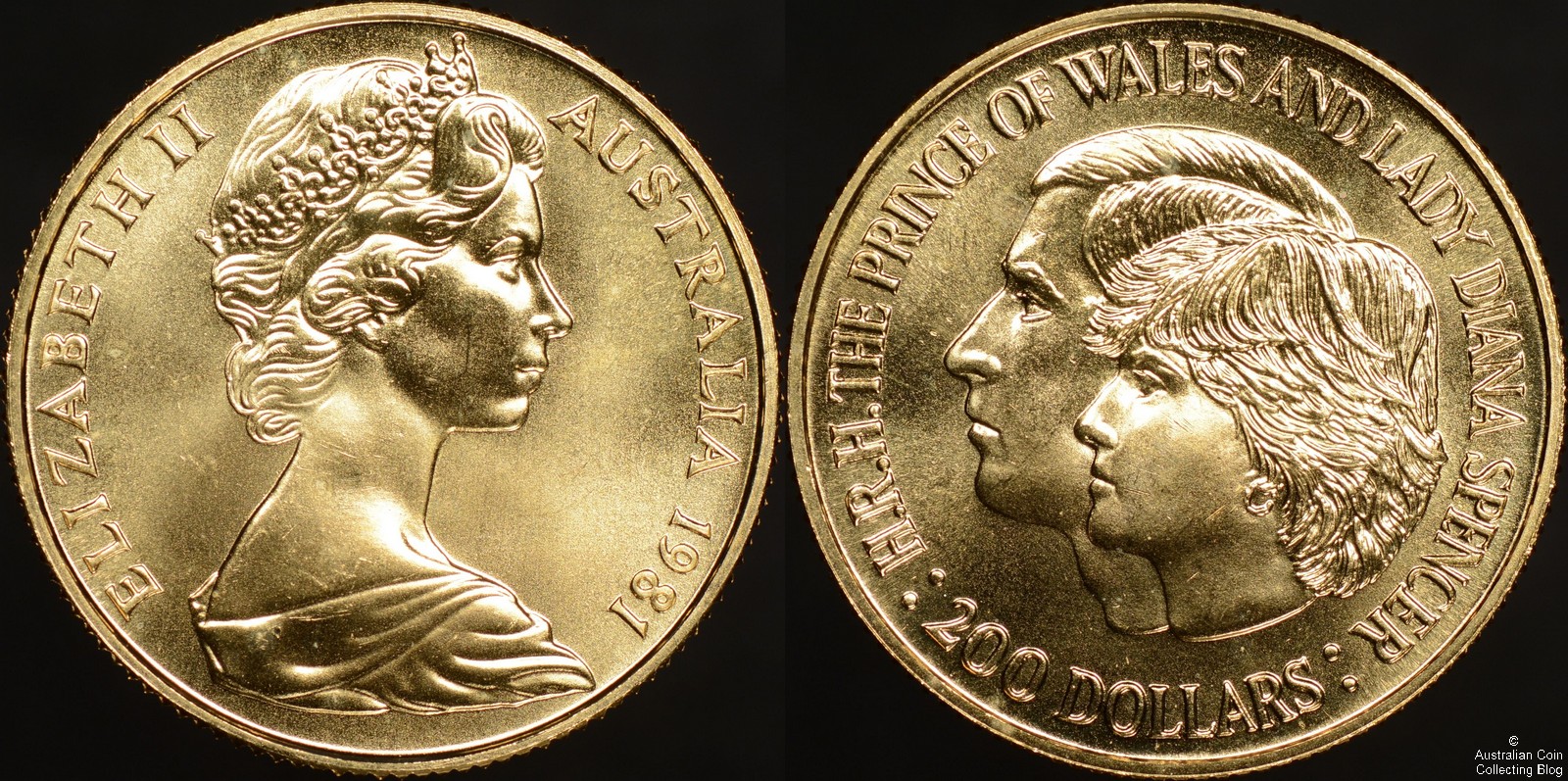
Australian $200 Gold Coin
AUD $87.04
Silver Price (per Oz)
AUD $6,299.32
Gold Price (per Oz)
USD $0.6642
Australian Dollar

 
These values are updated hourly using New York market prices. Coin values are purely the value of the gold or silver they contain and do not account for any numismatic value.
Prices Last Updated: 06:04 10 Dec 2025

Subscribe via Email

Enter your email address to subscribe to the Australian Coin Collecting Blog and receive emails about new posts.

Archives